Address
304 North Cardinal St.
Dorchester Center, MA 02124
Work Hours
Monday to Friday: 7AM - 7PM
Weekend: 10AM - 5PM

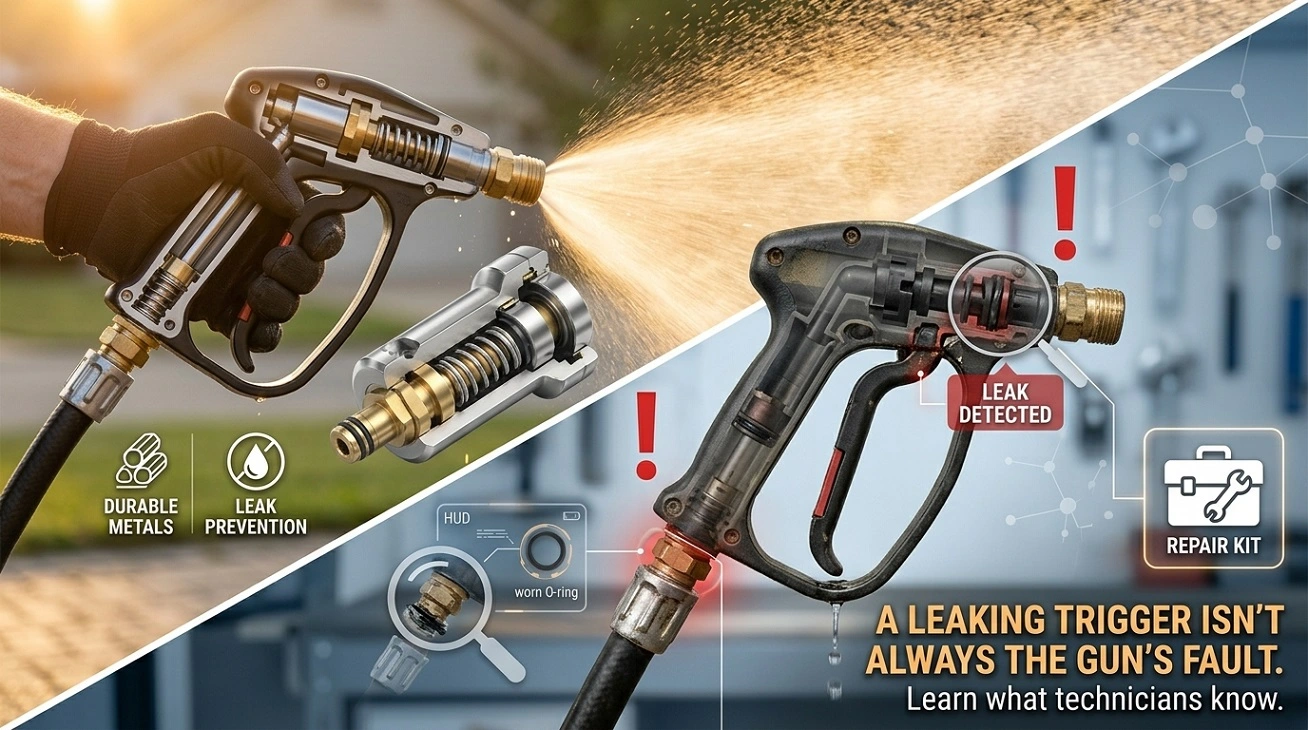
Quick summary: A pressure washing gun doesn’t generate pressure itself — it controls and directs water already pressurized by the pump — so the real differences between a good gun and a bad one come down to build material, trigger comfort, fitting compatibility, and nozzle selection rather than brand name alone. This PressureWashTips guide covers every type of pressure washing gun, how to choose and troubleshoot one, and includes specific product picks with real links for guns, nozzles, and foam cannons worth buying.
The handheld attachment that controls water flow on a pressure washer is most commonly called a “spray gun,” “trigger gun,” or simply “gun,” though “lance” is also frequently used, particularly for the extended wand portion that attaches to it. Some manufacturers and commercial users refer to the combined gun-and-wand assembly as a “gun and lance” or “wand assembly.” In professional and industrial contexts, you may also hear it called a “spray wand” or “cleaning wand.” Some people use “water blaster” informally to describe the entire machine rather than just the gun specifically, and outside North America, “jet washer” and “high-pressure cleaner” are common alternate terms for the same category of equipment entirely.
Regardless of which term you hear, its function stays consistent across every pressure washer: it houses the trigger mechanism that starts and stops water flow, connects to the pressurized hose coming from the pump, and holds the nozzle tip that determines the spray pattern and effective pressure at the point of contact with the surface. It’s worth understanding where the gun fits into the bigger picture, since a pressure washer as a whole consists of several core components working together: the motor or engine (electric or gas) powers the pump, which pressurizes water pulled in from your water source; the high-pressure hose carries that pressurized water to the gun; the nozzle, often interchangeable, attaches to the gun and determines spray pattern and effective force; most machines also include a detergent tank or injector system that mixes cleaning solution into the water stream at low pressure; an unloader valve regulates pressure and protects the pump when the trigger is released; and the inlet filter screens debris from your water supply before it reaches the pump.
The gun itself is genuinely just one link in that chain — but it’s the link you’re physically holding, which is exactly why its build quality, comfort, and reliability matter so much more in daily use than most buyers initially assume.
Yes, pressure washer guns are the standard delivery mechanism for virtually all consumer and professional pressure washers, and they work reliably when matched correctly to the machine’s PSI rating and maintained properly. This is worth stating plainly because it’s a genuinely common point of confusion: the gun itself doesn’t generate pressure at all. It controls and directs water that’s already pressurized by the pump, using the trigger to start and stop flow and the attached nozzle to determine spray pattern and force.
Most reliability issues attributed to “the gun not working” actually trace back to one of three causes: a clogged nozzle, a worn O-ring causing leaks, or a mismatch between the gun’s maximum rated PSI and the machine’s actual output. Quality guns with brass or stainless internal fittings generally provide years of reliable service, while cheap all-plastic guns are more prone to cracking or seal failure under sustained pressure. This distinction — brass/stainless versus all-plastic — comes up repeatedly throughout this guide, because it’s genuinely the single biggest predictor of whether a gun lasts two seasons or ten.
Do water pressure guns work? Yes — “water pressure gun” is simply another common term for the same trigger-controlled spray attachment, and it works identically. The gun relies entirely on the machine’s pump to generate pressure; its job is purely to control flow via the trigger and shape the spray pattern through an attached nozzle. Effectiveness depends heavily on nozzle selection rather than the gun itself — the same gun can feel dramatically more or less powerful simply by switching between a narrow 0° tip and a wide 40° fan tip, since the nozzle determines how concentrated the water stream actually is at the point of contact.
The most frequent issue is leaking around the trigger or connection point, usually caused by a worn or dried-out O-ring that simply needs replacing rather than indicating a bigger problem. This shows up constantly in real product reviews — one buyer of a Ryobi replacement trigger handle noted their unit worked fine overall but leaked a bit at the trigger, adding that they expected it would get worse over time, which is a textbook O-ring wear pattern rather than a defective unit (eBay product review).
Clogged nozzles are another common complaint, typically from mineral deposits or debris in the water supply, which restrict flow and reduce effective pressure at the tip. This is usually fixable in under a minute with a small pin or paperclip to clear the orifice, rather than requiring a replacement part.
Trigger sticking or failing to fully release can occur if internal components accumulate grime or corrosion over time, particularly if the gun isn’t rinsed and dried after use — a maintenance step that’s easy to skip but meaningfully extends gun lifespan.
Cracked housings are common on cheaper, all-plastic guns exposed to prolonged sun or freezing temperatures during storage. This is one of the clearest arguments for spending slightly more on a gun with reinforced plastic ribbing or a metal body if you’re storing equipment outdoors or in an unheated garage.
Mismatched fittings between the gun and machine, especially when replacing a broken gun with a non-manufacturer part, can also cause leaks or reduced performance if the connector isn’t a precise match. One real buyer review of an MTM Hydro replacement gun kit specifically flagged this exact scenario, noting they bought it as a replacement for a failed OEM Kärcher gun and discovered MTM had apparently manufactured the original OEM part — with the ball bearing, spring, and seal assembly having failed on the original — and that the redesigned replacement appeared to address that specific failure point (Amazon customer review). That’s a genuinely useful data point: gun failures often trace back to one specific internal component wearing out, not the gun “just breaking” randomly.
The best pressure washing gun depends on what you’re using it for, but a handful of features separate quality guns from cheap ones regardless of brand.
Start by confirming fitting compatibility. The gun’s fitting needs to match your specific pressure washer’s connector type and maximum PSI rating, since using a gun rated below your machine’s output can cause it to fail under pressure — a genuine safety concern given the forces involved, not just a performance issue. Fitting compatibility varies between brands and even between different product lines from the same manufacturer, so a gun that fits one Kärcher model won’t necessarily fit another. Universal or generic replacement guns work well as long as you confirm both the PSI rating and thread or quick-connect size match your machine before purchasing.
Prioritize a comfortable, ergonomic grip with a trigger lock. This matters more than people expect until they’ve held a trigger open for 30+ minutes on a real job — hand fatigue becomes a genuine factor at that point, and a trigger lock also prevents accidental discharge when you’re not actively spraying.
Quick-connect nozzle fittings save real time. If you’re switching between surfaces or spray angles during the same job, tool-free nozzle swaps add up to meaningful time savings over a full driveway or house-washing session.
Consider a dual-lance gun if you use detergent regularly. A dual-lance setup lets you toggle between a high-pressure rinse nozzle and a low-pressure detergent nozzle instantly, without swapping attachments mid-job — worth the modest price increase for anyone doing more than occasional light cleaning.
Brass or stainless internal fittings outlast plastic significantly. This is worth repeating one more time because it’s the single most consistent piece of advice across every source and forum discussion referenced in this guide: cheap all-plastic guns crack and leak; brass and stainless fittings hold up for years of regular use.
Standard trigger guns are the most common type, featuring a single nozzle connection and basic on/off control via the trigger, suitable for most everyday residential tasks like cars, patios, and light siding work. These are what ship stock with the vast majority of consumer machines, and for a homeowner doing occasional cleaning a handful of times per year, a quality standard trigger gun paired with a full nozzle set genuinely covers most needs without any further upgrade.
Dual-lance guns include two separate wands or a switchable mechanism, letting you instantly toggle between a high-pressure rinse nozzle and a low-pressure detergent nozzle without swapping attachments mid-job — the setup most professionals actually run. The real time savings shows up on larger jobs: rather than stopping to physically swap a nozzle tip every time you switch from applying soap to rinsing, a dual-lance gun lets you flip a lever or rotate the assembly in under a second, which adds up meaningfully across a full driveway or house exterior.
Adjustable or variable-pressure guns let you dial pressure up or down directly at the gun rather than switching nozzle tips entirely, offering more flexibility across different surfaces without carrying a full nozzle set. These are particularly useful for anyone regularly moving between genuinely different surface types in a single session — say, a car and then a driveway — since you can back off pressure at the gun itself rather than needing a dedicated low-pressure nozzle on hand.
Foam guns and foam cannons are specialized attachments designed specifically for thick, clinging detergent application, particularly popular for vehicle washing — covered in detail in the next section, since the distinction between the two genuinely matters and shouldn’t be treated as interchangeable terminology.
Extension or telescoping wand guns add reach for second-story work without requiring a ladder, letting you clean gutters and upper siding from the ground while holding a pressurized line. Beyond the safety benefit of staying off a ladder, these also solve a genuine physical constraint: holding a standard-length gun and wand at full arm extension overhead for any meaningful stretch of time is exhausting and imprecise, while an extension wand distributes that reach along the tool itself rather than your arm.
Rotary or turbo nozzle attachments spin the water stream for faster, more aggressive cleaning on tough concrete stains — essentially concentrating a narrow, high-pressure jet into a rotating pattern that covers more area than a static pinpoint tip while cleaning faster than a wide fan tip. These attach to the same gun and wand assembly as a standard nozzle, meaning you don’t need a dedicated gun for this function — just the rotary tip itself, making it one of the more cost-effective upgrades on this list for anyone regularly dealing with stubborn concrete stains.
Foam cannons generally outperform foam guns for anyone regularly washing vehicles. They attach directly to a garden hose or pressure washer and produce thicker, longer-lasting foam that clings to the surface, giving soap more time to lift dirt before rinsing — which matters enormously for paint safety, since more dwell time means less reliance on direct high-pressure contact to remove grime.
Foam guns, which typically attach directly to the pressure washer wand, tend to produce thinner foam and require closer proximity to the surface, increasing the risk of paint contact damage on vehicles specifically. For general exterior cleaning like siding or driveways, where foam thickness matters less, a standard foam gun setup is perfectly adequate and often less expensive.
For car enthusiasts prioritizing a gentler, more thorough pre-wash foam stage, a dedicated foam cannon is widely considered the better investment, even though it adds an extra piece of equipment to store and maintain. Specific product picks for both categories are covered in the recommendations section below.
Professional pressure washing setups typically pair a gas-powered machine, usually in the 3,000–4,500 PSI range with a Honda GX engine and triplex pump, with a dual-lance or quick-connect gun that allows fast switching between rinsing and detergent application. Many professionals also use a surface cleaner attachment for flat concrete, since it distributes pressure evenly and finishes large areas significantly faster than a handheld wand alone — a point covered in much more depth in our driveway pressure washing guide.
For siding and roofs, professionals switch to soft-washing equipment entirely, using a low-pressure pump sprayer or a dedicated soft-wash injector system rather than the high-pressure gun used for concrete. Extension wands are common for second-story work, avoiding the need for ladders entirely.
The combination of the right attachment for each surface — not just raw pressure — is what actually separates professional results from a typical DIY attempt. This is worth internalizing before you shop for a gun at all: a single “do everything” gun and nozzle combination is a compromise, and professionals typically carry two or three specialized setups rather than expecting one gun to handle a full property well.
Even the best pressure washing gun underperforms — or causes damage — if it’s paired with the wrong nozzle and pressure for the surface in front of you.
What PSI is needed to wash a house? Most house exteriors are safely and effectively cleaned in the 1,500–2,500 PSI range, with the exact number depending heavily on the siding material. Vinyl siding and painted wood need less pressure than most people assume, typically 1,300–1,600 PSI, to avoid forcing water behind panels or stripping the finish. Brick and stucco can generally tolerate somewhat higher pressure, up to around 2,500 PSI, since they’re more durable materials. Roofs are the major exception — professionals avoid pressure washing roofing entirely, using soft washing instead to prevent stripping protective shingle granules.
Is 2,500 PSI too much for siding? For most standard vinyl siding, yes — 2,500 PSI sits above the generally recommended range and increases the risk of forcing water behind panels or stripping the surface finish, particularly at close range or with a narrow nozzle. Vinyl siding typically only needs 1,300–1,600 PSI to clean effectively. If 2,500 PSI is all you have available, it can still be used on siding, but only with a wide 40° nozzle held well away from the surface, moving continuously rather than lingering in one spot. Brick, by contrast, tolerates 2,500 PSI comfortably, so the answer genuinely depends on your specific siding material.
What shouldn’t you power wash at all? Several surfaces are simply too delicate for direct power washing regardless of nozzle choice, and should either be avoided or cleaned with a soft-washing approach instead. Asphalt shingle roofs top the list, since high pressure strips protective granules and significantly shortens roof lifespan. Painted or aging wood siding, stucco, and fiber cement products like James Hardie siding can chip, crack, or have water forced behind the surface under too much pressure. Delicate items like window screens, outdoor electrical fixtures, air conditioning units, and older mortar joints between bricks or pavers are also at real risk. Antique or historic masonry, headstones, and any surface already showing cracks or structural wear should be avoided entirely with high pressure. As a general rule, if a surface is painted, porous, aged, or electrical, treat it with caution or switch to a lower-pressure soft-washing method instead.
Is Dawn dish soap good for cleaning concrete? Worth a brief mention here since it connects directly to gun and nozzle choice: Dawn dish soap works reasonably well for light, routine dirt on concrete, thanks to its strong degreasing properties, but it’s not the ideal choice for tougher oil stains or long-term regular use through a pressure washer’s built-in system. For genuine oil and grease stains, a dedicated concrete degreaser will outperform Dawn significantly. If using Dawn, dilute it well and apply it with a separate pump sprayer — or through a foam cannon, which bypasses the gun’s internal injection system entirely — rather than running it through a pressure washer’s built-in detergent tank, since its thick sudsing formula can clog the injection system over repeated use.
If you’re still deciding on your overall machine before worrying about gun and nozzle specifics, our electric vs. gas comparison is worth reading first, since the gun and nozzle you’ll want depends partly on which type of machine you’re pairing it with.
Kärcher and Simpson both have strong reputations for gun quality, generally including brass or stainless internal fittings and durable trigger mechanisms across their product lines, whether purchased separately or included with a machine. Generac and Ryobi also produce reliable, well-reviewed guns as part of their residential and commercial pressure washer packages.
For aftermarket or replacement guns specifically, brands like MTM Hydro and General Pump are widely trusted in the commercial and detailing space for their rebuildable, heavy-duty construction — MTM Hydro in particular shows up constantly in car detailing and mobile wash circles for its Italian-made trigger guns and foam cannon systems, several of which are covered directly in the product recommendations below.
Rather than searching for one single “best” gun brand, prioritize matching the gun’s maximum PSI rating and connector type to your specific machine, since even a well-made gun from a reputable brand won’t perform reliably if it’s mismatched to your pressure washer’s actual output or fitting size.
Here are specific, currently available picks across the categories covered in this guide. Links go directly to the product listings so you can review current pricing and specs.
MTM Hydro SGS28 Pressure Washer Trigger Gun with Installed Stainless Steel Connection Fittings — a genuinely commercial-grade gun with stainless fittings pre-installed to eliminate leak points at installation, widely used in the professional detailing and mobile wash space. View on Amazon
MTM Hydro Acqualine SGS35 Pressure Washer Gun, 5000 PSI, Stainless Steel Quick Connect Fittings and Live Swivel — the live swivel feature specifically prevents hose tangling during continuous use, a genuinely underrated feature once you’ve used a gun without one for an extended job. View on Amazon
MTM Hydro 3000 PSI Consumer Gun Kit — a well-reviewed, affordable replacement gun that real buyers have specifically used to replace failed OEM Kärcher guns, addressing the exact ball-bearing and seal failure point that tends to fail on factory-installed units. View on Amazon
MTM Hydro 20″ Pressure Washer Extension Wand and SGS28 Spray Gun Kit — combines a quality trigger gun with a 20-inch bent stainless lance, rated to 4,060 PSI and 320°F, ideal for gutters and upper siding without a ladder. View on Amazon
MTM Hydro Ultimate PF22.2 Foam Cannon Gun Kit — pairs the SGS35 gun with an adjustable-output foam cannon specifically designed for auto detailing, car washing, boats, and roofs, with a chemical injection knob to control foam thickness. View on Amazon
MTM Hydro Original Foam Cannon and M407 Pressure Washer Trigger Gun — a more affordable foam cannon and gun bundle that still includes an adjustable chemical injection knob, suitable for home car washing and general exterior cleaning alike. View on Amazon
5-Pack Universal Quick Connect Pressure Washer Nozzle Tips (0°, 15°, 25°, 40°, 65° Soap) — a full color-coded nozzle set covering every angle discussed throughout this guide, rated up to 4,500 PSI and compatible with most 1/4″ quick-connect wands. View on Amazon
Sun Joe 5-Pack Quick-Connect Pressure Washer Spray Tips (SPX3000-TPS) — the manufacturer’s own replacement nozzle set for Sun Joe SPX3000, 4000, 6000, and 9000 series machines, ensuring a guaranteed fit rather than a generic universal set. View on Amazon
Briggs & Stratton 6198 O-Ring Replacement Kit — a genuine OEM kit designed to restore worn O-rings across guns, hoses, and wands, and includes a garden hose inlet filter as well. Given that worn O-rings are the single most common cause of gun leaks covered throughout this guide, keeping one of these on hand is one of the cheapest ways to extend a gun’s usable life by years rather than replacing the entire unit at the first sign of a leak. View on Amazon
Note: as an editorial team, we haven’t independently tested every listed product — these picks are based on specs, verified buyer reviews, and consistent reputation across detailing and pressure washing communities. Always check current listings for up-to-date pricing, compatibility, and reviews before purchasing.
Buying a quality gun is only half the equation — even the best brass-and-stainless trigger gun will eventually develop leaks or sticking if it’s never maintained. After each use, rinse the exterior of the gun to clear detergent residue, which is mildly corrosive to seals over time if left to dry repeatedly. Periodically disconnect the nozzle and check for debris or mineral buildup in the tip, since this is the single most common cause of reduced spray performance that gets mistakenly blamed on the gun or pump. If you notice the trigger becoming stiff or slow to fully release, a small amount of silicone-based lubricant (never petroleum-based, which can degrade rubber seals) on the trigger pivot point usually resolves it. And if you’re storing equipment through a winter, disconnect the gun from the wand and hose entirely, since residual water trapped in the gun’s internal chamber is a common source of cracked housings after a hard freeze — a problem worth avoiding given how much of this guide has been devoted to exactly that failure mode.
Product listings and spec sheets tell you what a gun is rated for. Real buyer reviews tell you what actually happens after weeks or months of use — and the pattern that emerges across them lines up closely with the “brass and stainless beats plastic” advice repeated throughout this guide.
One verified buyer of the MTM Hydro SGS28 stainless steel gun, reviewing it after real use, specifically praised its no-leak performance compared to other guns they’d owned, noting that changing tips had been a recurring problem with previous guns due to trigger leaking, but this one held up without issue — adding that the easy-pull trigger reduced fatigue on long washing days and that the swivel feature prevented hose tangling during use (eBay seller review). That’s a genuinely useful real-world confirmation of exactly the two features this guide recommends prioritizing: leak-resistant fittings and a comfortable trigger pull.
On the replacement-parts side, a buyer of a Ryobi OEM-style replacement trigger handle reported it worked well overall and matched the original closely, but noted a slight leak at the trigger that they expected would worsen over time — a direct, real-world illustration of the O-ring wear pattern described earlier in the troubleshooting section, coming from an actual buyer rather than a general warning (eBay product listing). Multiple other buyers of the same replacement part reported it fit perfectly and worked “like brand new,” with one specifically noting it performed better than their original factory gun — a reminder that aftermarket replacement guns aren’t automatically a downgrade from OEM parts, and are sometimes a genuine upgrade.
The consistent theme across these real reviews: gun quality is judged almost entirely on two things by actual owners — does it leak, and is it comfortable to hold for an extended job. Everything else, including brand name, matters mainly insofar as it predicts those two outcomes.
Beyond the basic PSI and fitting match covered earlier, a few specific compatibility mistakes come up often enough to deserve their own section.
Buying a gun rated below your machine’s actual output. This isn’t just a performance issue — it’s a safety issue. A gun rated for 3,000 PSI installed on a machine capable of 4,000 PSI can crack or blow apart under sustained pressure, and given the documented risk of serious injury from high-pressure water at close range, a failed gun fitting during use is a genuine hazard, not just an inconvenience. Always check both the gun’s maximum rated PSI and its rated GPM against your specific machine’s output before installing it, not just one or the other.
Assuming “quick connect” means universal. Quick-connect fittings come in several different standard sizes — most commonly 1/4″ and 3/8″ — and while the mechanism looks similar across brands, a 1/4″ quick-connect gun will not physically seat into a 3/8″ fitting no matter how much force you apply. Several of the replacement gun and nozzle products referenced in this guide explicitly list which sizes they support for exactly this reason; checking that spec before ordering saves a return shipment.
Overlooking thread type on threaded (non-quick-connect) fittings. Some machines, particularly certain Kärcher models and older units, use proprietary threaded connections rather than the more universal M22 or quick-connect standard. If you’re replacing a gun on one of these machines, either buy the manufacturer-specific replacement or confirm an adapter is included, since a generic universal gun may simply not thread onto a proprietary fitting at all.
Ignoring maximum water temperature ratings. This matters more than most buyers realize if you’re using a power washer (heated water) rather than a standard cold-water pressure washer. Cheaper guns, especially all-plastic models, often have a meaningfully lower maximum temperature rating than their PSI rating alone would suggest, and running hot water through a gun not rated for it can cause premature seal failure or even warping of plastic components, independent of pressure entirely.
Foam cannons generally outperform foam guns for anyone regularly washing vehicles, since they attach directly to a garden hose or pressure washer and produce thicker, longer-lasting foam that clings to the surface, giving soap more time to lift dirt before rinsing. Foam guns, which typically attach directly to the pressure washer wand, tend to produce thinner foam and require closer proximity to the surface, increasing the risk of paint contact damage on vehicles specifically. For general exterior cleaning like siding or driveways where foam thickness matters less, a standard foam gun setup is perfectly adequate and often less expensive. For car enthusiasts prioritizing a gentler, more thorough pre-wash foam stage, a dedicated foam cannon is widely considered the better investment, even though it adds an extra piece of equipment to store and maintain.
Start by confirming the gun’s fitting matches your specific pressure washer’s connector type and maximum PSI rating, since using a gun rated below your machine’s output can cause it to fail under pressure. Prioritize a comfortable, ergonomic grip with a trigger lock, especially if you’ll be using it for extended jobs, since hand fatigue becomes a real factor after 30 minutes or more of continuous use. Quick-connect nozzle tips save significant time if you’re switching between surfaces during the same job. If you regularly use detergent, a dual-lance gun that lets you toggle between a rinse nozzle and a soap nozzle without swapping attachments is worth the modest price increase. Brass or stainless internal components generally outlast all-plastic guns, particularly for anyone using the machine more than a few times a year.
The best pressure washing gun depends on what you’re using it for, but a few features separate quality guns from cheap ones regardless of brand. Look for a gun with a comfortable, ergonomic grip and a trigger lock, which prevents accidental discharge and reduces hand fatigue during longer jobs. Quick-connect nozzle fittings are worth prioritizing, since they let you switch between spray angles without tools mid-job. Dual-lance guns, which let you flip between two different nozzles instantly, are especially useful for switching between rinsing and detergent application. Brass or stainless-steel internal fittings tend to outlast plastic components significantly, particularly if you’re using the machine regularly. Rather than chasing a specific brand name, prioritize build material, trigger comfort, and quick-connect compatibility with your specific machine’s fittings.