Address
304 North Cardinal St.
Dorchester Center, MA 02124
Work Hours
Monday to Friday: 7AM - 7PM
Weekend: 10AM - 5PM


Your outdoor furniture has survived seasons of weather… but can it survive your cleaning routine?
“I have withstood the frost of November and the fury of August. I have suffered the indignity of bird droppings and the slow rot of the mildew upon my surface. I have begged for nothing but a kindly hand and, once or twice, a soft soap solution. Instead, thou hast returned with a machine of immense fury, set to maximum, pointed directly at my grain, and called it “care.” I am not dirt. I am your furniture. And I am begging thee to stop.”
Had Shakespeare lived today, he would not have written a tragedy of kings and betrayals. He would sit on your patio. Watch you pressure wash your wicker loveseat at full blast, and he would cry. Then he would write a sonnet. As nothing in all of Hamlet’s suffering quite captures the quiet devastation of outdoor furniture meeting its owner on cleaning day.
That’s your patio set. If it could talk. After what most people put it through during a cleaning session, it absolutely would.
Please take a moment to step out to your patio. What do you have out there? A wooden bench? Plastic chairs? A wicker loveseat? Metal table frame? Maybe some combination of all of the above?
Now here’s the question. Did you apply the same amount of pressure to all of them? This is one of the critical errors to be cautious of.
Wood and wicker are delicate. They bruise, they splinter, and they take up water in a manner that leaves long-term structural damage when you hit them too hard. Plastic is less demanding and yet cracks and scuffs when subjected to aggressive force. Metal usually can withstand more, but powder-coated or painted metal loses its coating easily unless you exercise great care. Natural rattan is perhaps the most fragile of all. Too much pressure and you’re not cleaning it; you’re unraveling it.
One pressure setting for all of them is not efficiency. It’s just damage distributed evenly across your entire patio.
There is something deeply satisfying about turning a pressure washer all the way up. It feels powerful. It feels productive. The dirt doesn’t stand a chance.
Except here’s what’s in fact happening. High PSI doesn’t just remove dirt. It removes whatever is beneath the dirt, too. It gouges wood grain, leaving behind a surface that looks textured in all the wrong ways. It strips paint and sealant off metal furniture, leaving it exposed to rust. It crimps and warps plastic. And the damage doesn’t always show up immediately, which is the cruel part. Your furniture looks clean for a week or two. Then the warping begins. The cracking starts. The finish looks wrong, and you can’t quite figure out why.
For most outdoor furniture, you want to stay between 500 and 1,200 PSI, depending on the material. Start low. Go up only if genuinely needed. The dirt will still come off. The furniture will still be standing next season.
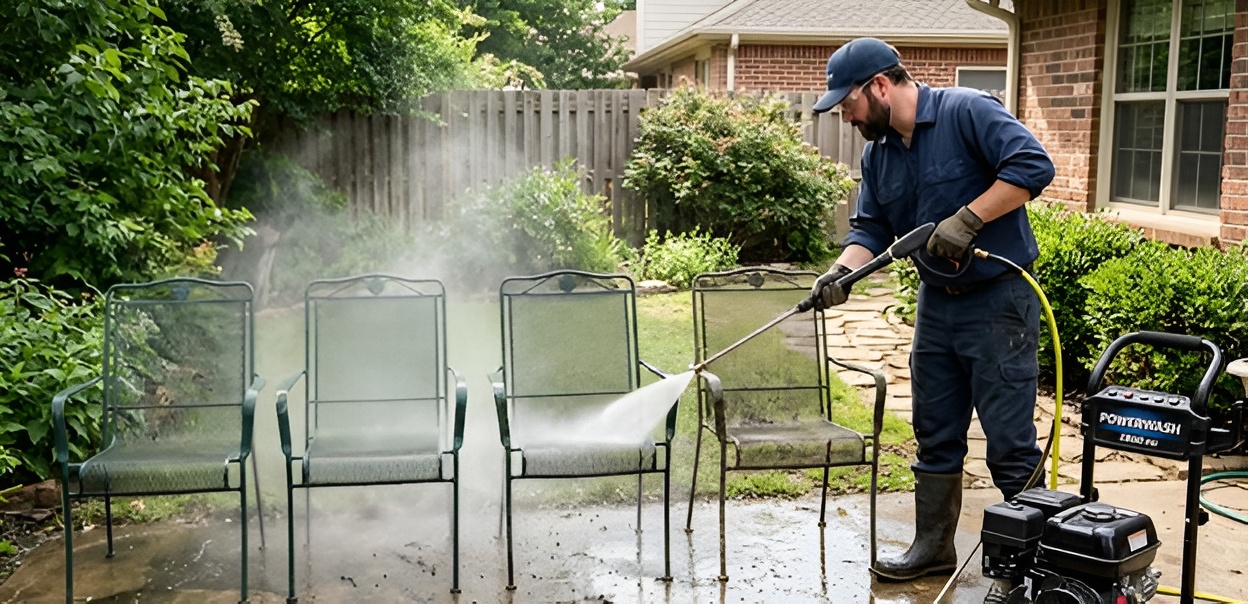
It is at the nozzle that most people commit a silent, invisible error that brings about very visible harm.
A zero or 15-degree nozzle focuses all that pressure in a narrow, violent jet. That nozzle is for concrete. For driveways. For surfaces that can take a beating without flinching. It is not for your teak bench or your resin chairs.
The 40-degree white nozzle is the default for outdoor furniture. It distributes the pressure on a broader surface area. This implies that you can achieve cleaning power without the concentrated force that causes cuts and splinters. A 25-degree nozzle will be suitable in cases where the pieces are sturdier, but the 40-degree nozzle must always be your starting point. Using the incorrect nozzle will turn a cleaning session into something your furniture will be recovering from for the rest of its outdoor life.
Also Read: What Is The Best Hose To Use For A Pressure Washer?
People see dirty cushions, and they think, logically, that the pressure washer that just handled the chair frame can handle the cushion too. It cannot.
High-pressure water doesn’t just clean fabric. It drives water deep into the foam underneath, past any point that airflow can reach in a normal drying window. That trapped moisture becomes a mold situation within days, growing from the inside out while the outside of your cushion looks perfectly fine. It is too late to do something about it when you smell it.
Cushions should be cleaned with a small amount of soap and a soft brush or a light machine wash in case the cover can be removed. That’s it. The pressure washer must not come close to them. Not even with good intentions on a low setting.
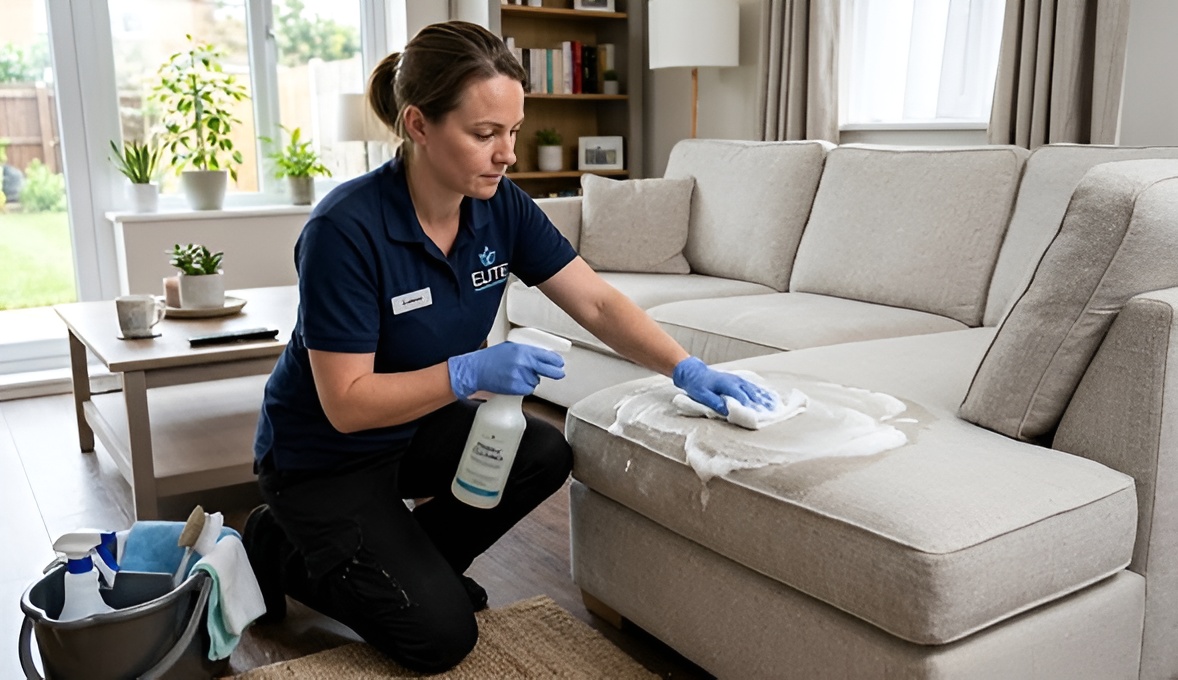
The pressure washer is not step one. Most people treat it like it.
Skipping a basic pre-rinse and brush-down before pressure washing prevents the removal of loose grit and debris. The force of the water drives them directly to the surface. Those fine particles act like sandpaper under pressure, scratching and abrading the material before the actual cleaning has even started. That scratch on your plastic chair that appeared out of nowhere? That’s where it came from.
Brush off the loose debris first. Give everything a gentle rinse. Then bring in the pressure washer to handle what remains. The sequence matters more than most people realize.
You’ve done the work. The furniture looks excellent. You put the machine away and go inside. Job done.
Except wood that sits wet in the sun gets warped because the moisture does not spread evenly across it. Rust quietly forms in the joints, legs, and hollow frames of the metal. Wicker also gets weakened when left soaked.
After pressure washing, dry your furniture down. A microfiber cloth handles the obvious surfaces. When it comes to wood, a follow-up of sealant after it is completely dry is not optional. It’s the difference between furniture that will last ten years and furniture that will look old by the next spring.
If you are unsure of the settings, nozzles, or material-by-material approach that each piece requires, leave the job to an expert. It costs considerably less than replacing an entire patio set because the cleaning session went wrong.
Your furniture has been out there through everything. The least it deserves is someone who knows what they’re doing when it finally gets cleaned.