Address
304 North Cardinal St.
Dorchester Center, MA 02124
Work Hours
Monday to Friday: 7AM - 7PM
Weekend: 10AM - 5PM


Why do professionals prioritize GPM over PSI? The answer could save you hours of work.
You’re standing in the hardware store aisle, pressure washer box in each hand, doing the only logical thing a sensible person would do: comparing the highest number printed on each label.
One says 3,200 PSI. The other says 2,800 PSI. Decision made.
You go home with the 3,200. It feels correct. Authoritative. Like choosing the faster horse.
And then you spend an entire Saturday afternoon pressure washing your driveway, moving slower than you expected, and rewashing the same patch three times, vaguely suspecting you’ve been cheated.
You haven’t been cheated. You’ve just been reading the wrong number. The pressure washer industry has quietly allowed PSI to hog all the glory for decades. While GPM? The one who determines how fast and well you clean sits in the footnotes, largely ignored.
Today we’ll fix that!
PSI stands for pounds per square inch, and it does exactly what it sounds like. It measures the force with which water leaves the nozzle and hits the surface you’re cleaning.
Think of PSI as the opening punch. It’s what breaks the bond between stubborn grime and the surface it has spent months making itself at home on. PSI effectively removes baked-on grease from garage floors, calcified algae from brick walls, and old paint that has lingered for too long. Without sufficient pressure, you’re essentially asking dirt to leave politely, and dirt, as a rule, does not respond to politeness.
The story gets interesting here. Additional PSI is not necessarily a gift. High PSI when in the wrong hands or against the wrong surface removes paint, elevates the wood grain, and causes water to enter areas not meant for hydration.
PSI is also only half the conversation.
GPM stands for gallons per minute, and it measures something far less dramatic than force. It measures flow. How much water your machine is pushing through the nozzle every minute.
No one types GPM on the front of the box in big font. It does not sound good at a backyard barbecue. “I got a 4.0 GPM machine;” it doesn’t carry the same energy as “I got a 3,500 PSI beast.” Hence, GPM is arguably the most important factor in job speed and surface cleanliness.
PSI is the punch that loosens the dirt. GPM is the river that carries it away. You can hit harder than anyone else in the world. Nevertheless, if there isn’t enough water to wash away the dirt, you’re simply moving it around.
What is better? Scrubbing tile with a toothbrush or a four-inch brush with the same pressure on each bristle? The latter. Of course. The broader brush is able to cover more area at once; thus, it cleans quicker. GPM is no different. The more water that strikes the surface, the more work it accomplishes in a single second.
Professional cleaners always use higher GPM machines in preference to raw PSI. Speed and coverage matter more to them than brute force. The job gets done faster, the surfaces stay unharmed, and the day ends earlier. Coffee time!
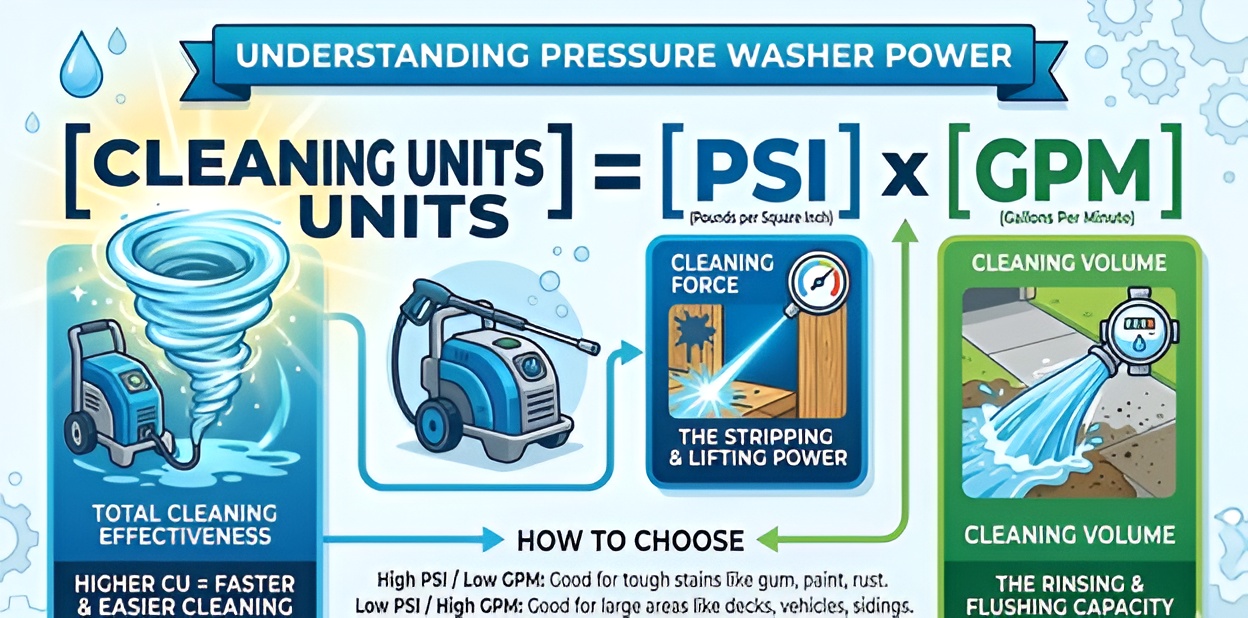
This is where the math gets genuinely useful. Ah Quadratic formula? Still irrelevant.
Multiply PSI by GPM and you get what the industry calls Cleaning Units, or CU. This single figure gives you a far more honest picture of what a machine is actually capable of than either number alone.
A pressure washer rated at 3,000 PSI and 2.0 GPM has 6,000 Cleaning Units. So does a machine rated at 2,000 PSI and 3.0 GPM. Same score. Same box price, perhaps. Entirely different performance depending on what you’re cleaning.
The second pressure washer will deliver the faster clean, as it can rinse away dirt more efficiently. However, the first, with the higher PSI, is the better tool for an application requiring paint stripping or other high-power work.
This is the nuance that spec sheets skip entirely. Two machines can be equal on paper and utterly different in practice. Once you understand Cleaning Units, you stop shopping by one number and start shopping by the right combination for your actual situation.
If your priority is shifting stubborn stains like concrete oil, calcified mineral deposits, or layered grime that has been on your driveway since a different presidential administration, then PSI is your lead character. You need force to break those bonds first. No amount of gentle rinsing will substitute for that initial impact.
GPM is the more useful one, though, when you need to get over large areas in a short time, such as washing siding, rinsing a long line of fences, or cleaning a garage floor at the end of a muddy winter. You don’t need an aggressive strike. You need volume, coverage, and pace. A high-GPM machine will get you off the driveway and back inside significantly sooner.
For most homeowners doing general exterior maintenance, a balanced machine in the 2,000–2,800 PSI range paired with a solid 2.0–2.5 GPM will handle almost everything without overdoing it on either front.
|
Task |
PSI Range |
GPM Range |
Priority |
|
1,200 – 1,900 PSI |
1.0 – 1.5 GPM |
Low PSI, control over volume |
|
|
1,300 – 1,600 PSI |
1.5 – 2.0 GPM |
Balance of both |
|
|
2,500 – 3,000 PSI |
2.0+ GPM |
PSI-led, GPM for speed |
|
|
1,500 – 2,000 PSI |
2.5+ GPM |
GPM-led, moderate PSI |
|
|
3,000 – 5,000 PSI |
3.5 – 5.0 GPM |
High GPM with detergent |
The next time you’re standing in that aisle with a box in each hand, flip it over. Find both numbers. Do the multiplication. And buy the machine that fits the job. Not the one that sounds the most impressive at a barbecue.
Your driveway will thank you. Your Saturday afternoon, finally finished before dark, will thank you even more!
Read Next: Top 8 Best Pressure Washer Under 200