Address
304 North Cardinal St.
Dorchester Center, MA 02124
Work Hours
Monday to Friday: 7AM - 7PM
Weekend: 10AM - 5PM

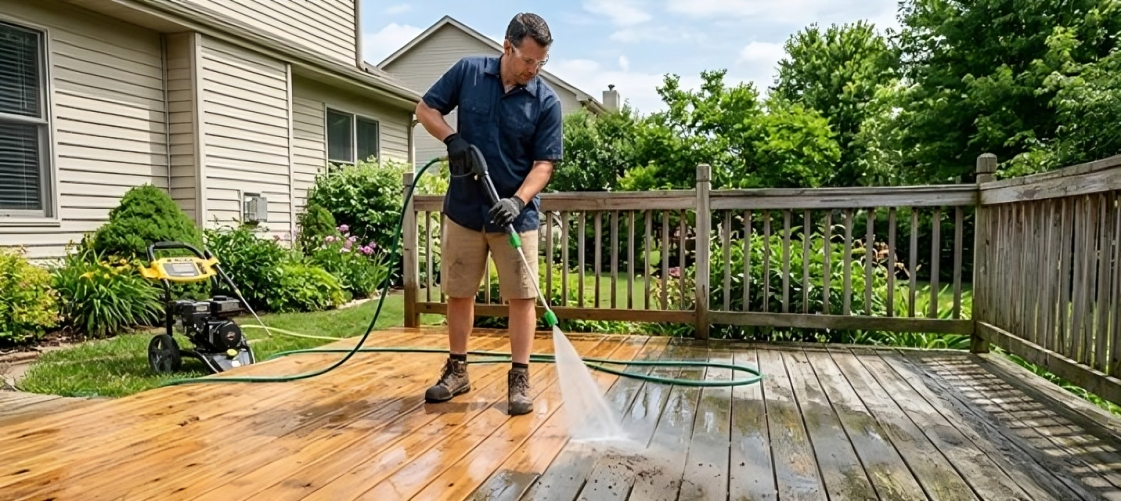
Think pressure washing is simple? One small mistake can leave lasting damage on wood.
There’s something almost sacry about a wooden deck at golden hour. The warm planks humming with the last breath of sunlight. A cold drink sweating on the railing. The faint memory of last summer’s barbecue still somehow lingering in the air. Your deck has seen things; carried laughter; survived winters; and held your family together.
And then you show up with a pressure washer.
Suddenly, the holy becomes a crime scene. Splintered wood. Fuzzy fibers rising like tiny distress signals. Tiger stripes burned into planks that took years to age gracefully. The deck didn’t deserve this. It trusted you.
The twist? Well, pressure washing your wooden deck isn’t the villain of this story. Doing it wrong is. With the right technique, the right settings, and just a little respect for the wood beneath your feet, that pressure washer becomes less “wrecking ball” and more “magic wand.” Your deck gets its glow-up. You get the credit. Everyone wins.
So let’s talk about how to do this without turning a Saturday afternoon into a full-blown regret spiral.

Let us begin with the most important number of all, PSI, or pound per square inch. It is simply the intensity of the machine hitting the surface. And with wood? You do not want to be in full beast mode, do you?
The sweet spot for most wooden decks sits between 1,000 and 1,500 PSI. That’s enough muscle to blast away grime and its ally, mildew. And yes! That mysterious green stuff as well, without shredding your boards in the process. The softer ones, such as pine and cedar, are placed on the more sensitive end; hence, maintain it nearer to 1,000 PSI. Hardwoods such as teak or ipe can withstand a little more, but don’t let that be an excuse to crank it up unnecessarily.
Think of it this way: using 3,000 PSI on a pine deck is like using a sledgehammer to crack a walnut. Satisfying for about half a second. Catastrophic immediately after.
If your pressure washer only goes high, don’t panic. You have other ways to tame the demon, and we’ll get to those right now.
Let us reveal a secret the pressure washing world doesn’t advertise loudly enough: the nozzle does half the work. Same machine, different tip, wildly different results.
For wooden decks, you’re looking at two friends:
And then there’s the one you leave in the bag. Always.
Beyond the tip, maintain a distance of 12 to 18 inches from the surface. Any closer and you’re essentially weaponizing water. Any further and you’re just giving your deck a light mist and calling it a day. Neither helpful nor satisfying.
Also Read: Top 8 Best Pressure Washers Under 200
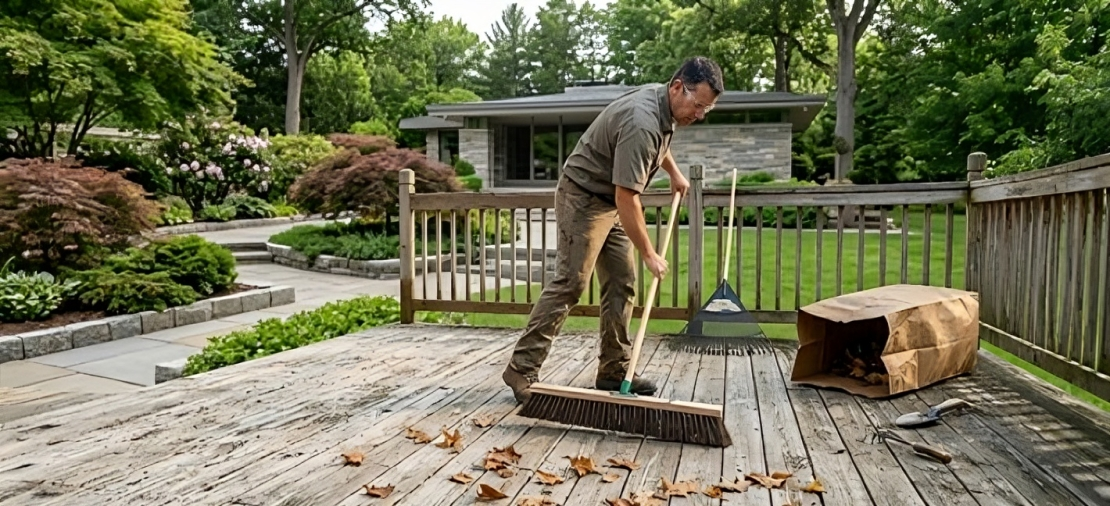
We get it. You want to skip straight to the satisfying part. The blasting. The before-and-after transformation. However, skipping prep work on a wooden deck is how good intentions become expensive lessons.
Follow the checklist and nothing can go wrong:
Clear the deck completely. Furniture, planters, grills, that one chair nobody uses but everyone keeps? Move it all. Water has a talent for finding things you forgot to protect.
Sweep away loose debris first. Leaves, dirt, and twigs don’t need a pressure washer. A broom gets those done in two minutes flat, saving you from turning wet debris into projectiles.
Pre-treat with a deck cleaner. Use a light deck cleaning solution, let it sit for 10 to 15 minutes, and leave the chemistry to do the hard work before even the water enters the picture. This softens mold, mildew, and deep-seated dirt such that you are not putting all your strength behind it.
Inspect for damage before you start. Loose boards, popped nails, rotting sections. Pressure washing over compromised wood doesn’t clean it. It accelerates the damage. If something looks questionable, it probably is.
This is where people go wrong most often. They think pressure washing is just pointing and spraying. It is not. There’s an art to it. A rhythm. Almost a philosophy, if you’re feeling dramatic about home maintenance.
Always move with the grain, never against it. Wood has a natural direction. Fighting it with a high-pressure stream is a great way to raise fibers, cause splintering, and leave marks that won’t stand out easily. Follow the grain like you’re brushing hair. Gently, consistently, in one direction.
Next, use long, even strokes. Slow and steady, overlapping each pass slightly. No hovering in one spot, hoping it’ll get cleaner faster. It won’t. It’ll just get damaged faster. That’s not the same thing. Instead of starting and stopping your stroke abruptly on the wood, begin and end each pass slightly off the edge of the board. This prevents harsh start-and-stop marks that create visible lines across your deck.
Lastly, watch for fuzzy fibers. If you see the wood surface starting to look like it grew a tiny beard, that’s your signal. You’re either too close, too high on PSI, or both. Back off immediately. The wood is telling you something, and unlike most things in home improvement, it’s being pretty direct about it.
You did it. The deck looks incredible. You’re feeling like an absolute legend. Don’t ruin it now by rushing the finish.
Let it dry completely. 48 to 72 hours minimum. We know that sounds like an eternity when you’re excited to seal or stain. Nevertheless, it is like pouring money down the drain, putting anything on wet wood. The water that collects there under will blister, peel, and destroy your finish quicker than you can say, “I should have waited.”
Also, gently rub the surface with fine-grit sandpaper to allow the sealant to bond.
The most courageous act sometimes is to lay down the pressure washer and, instead, pick up the phone
If you’ve never operated a pressure washer before and you’re starting your learning curve on a deck that took years to build, maybe don’t. Call a professional deck washer; they bring the right equipment, the right solutions, and the hard-won knowledge of what not to do.
If you are determined to conquer the world, or more like the wooden deck? Go slow. Follow the grain. Let it dry. And maybe, just maybe, that golden hour magic comes back better than ever.
Read Next: Highly Recommended Pressure Washing Companies for Deck Cleaning