Address
304 North Cardinal St.
Dorchester Center, MA 02124
Work Hours
Monday to Friday: 7AM - 7PM
Weekend: 10AM - 5PM


One fence absorbs damage. The other hides it. Are you cleaning yours the wrong way?
Remember when a crazy toy collector beat up Woody and sewed him back together in Toy Story? While Buzz Lightyear was throwing himself down staircases, believing he could fly.
Yeah. That’s your fence situation right there.
Your wood fence is Woody. Classic, full of character, but genuinely fragile underneath all that charm. If you point a pressure washer at it the wrong way, you’re basically Sid with a magnifying glass. Your vinyl fence, on the other hand, is Buzz. Shiny, confident, low maintenance, and absolutely convinced it can handle anything. And honestly? It can handle more than wood. However, “more than wood” does not imply that you can indiscriminately use any material and consider it sufficient.
Both of them need care. Just very, very different kinds of care.
So before you drag out the pressure washer and go full Sid Phillips on your fence, let’s talk about what wood and vinyl in fact need and how to make sure your fence survives the experience.
Your fence is outside. Every single day. In all of it: blazing sun, pouring rain, humidity, wind, and whatever that mysterious green stuff is that appears every spring, like it pays rent.
Over time, both wood and vinyl fences collect the same villains. Dirt. Mold. Mildew. Algae. UV damage. The difference is how each material reacts to all of that. And that contrast is everything.
Wood soaks it in. Literally. It’s porous, which means moisture, mold spores, and grime don’t just sit on the surface. They work their way through the grain and set up a permanent address. Left alone long enough, this leads to rot and warping (that’s Einstein’s department, not your fence’s).
Vinyl, in comparison, doesn’t absorb anything. It’s non-porous, so the grime stays on the surface. This sounds like a win until you realize that algae and mildew begin their happily ever after on it. They just sit there. Very visible. Highly stubborn.
Same enemies. Entirely different battlegrounds. This suggests that the cleaning approach can’t be the same either.
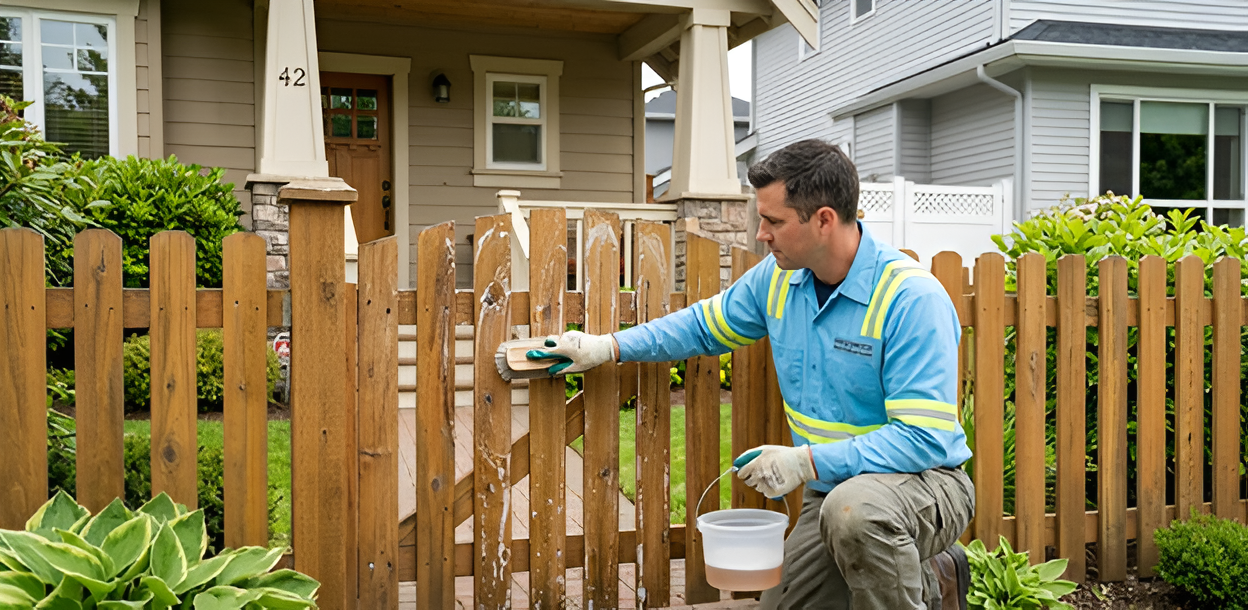
Woody did not spend all those years in Andy’s room by being tossed around recklessly. And your wood fence is not going to withstand a pressure washing session where one cranks up the PSI and hits the town without second thought.
Wood is porous and fibrous, and it bruises. It does not simply get cleaned when under high pressure. Instead, it almost destroys the surface, splits fibers, leaves scars on the grain, and drives water to where it should not possibly be. That dampness then develops into a permanent mold and rot problem that cannot be remedied later by cleaning.
So what does wood simply need? Low pressure. We’re talking 500 to 800 PSI at the maximum! And that’s for hardwood. Softwood wants even less. You also need a cleaning solution that won’t hurt wood. A soft-bristled brush for tough spots and some patience. Apply the solution. Let it sit for a while. Scrub gently, and then rinse well. That’s it. That’s the whole thing.
Treat wood gently and it’ll last decades. Blast it like you’re punishing it for something? You better start saving now to replace the panels before the year is out.
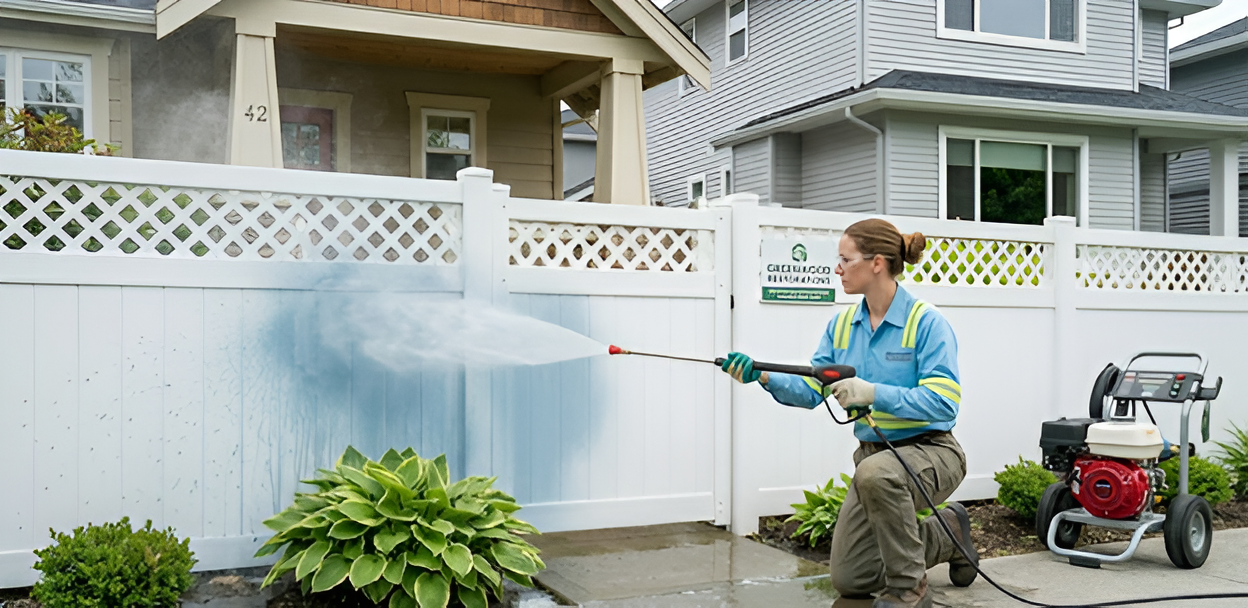
Buzz Lightyear spent a whole film believing that he was a real space ranger and could do anything. It doesn’t rot. It doesn’t warp from moisture the way wood does. It doesn’t need staining or sealing. It just appears daily, like I am okay; do not worry about me.
Vinyl is a lot stronger than wood. We won’t act like that’s not the case. It can also handle more pressure and doesn’t get damaged by moisture. Nevertheless, vinyl still has its limits. Ignoring them is where people go wrong.
Aggressive pressure forces water into the hollow posts, where it gets trapped and causes problems from the inside out. And when there is a color to your vinyl besides white? Well, high-pressure or unequal cleaning takes away the finish, and you are left with a fence that has gone through something traumatizing.
The right approach? Begin small, 500 to 800 PSI. Only increase when there is a real need, say, to 1500 PSI when faced with a truly stubborn situation. Use a mild cleaner specially developed for vinyl. Additionally, a soft brush can get to the spots that water can’t reach. Work in small sections. Rinse well, and be sure to clean the edges and caps. Dirt likes to hide there.
Neither of them wants you going full blast.
The most frequent fence-cleaning error is simply picking up a pressure washer, setting it to maximum, and then using it to complete the entire task as if you were competing in an event. It feels productive. It looks dramatic. Sadly, it leaves a trail of destruction that shows up weeks or months later, when you wonder why your fence looks worse than when you cleaned it.
The nozzle matters too. A 25–40 degree nozzle is your friend for fences. This method distributes pressure across a wider surface area, rather than concentrating it into a jet that causes more damage than cleaning. Narrow nozzles are for concrete and driveways. Not for fences. Not ever.
One pressure washer. Two completely different approaches. That’s the whole point.
Professional fence cleaners know the PSI for each material without guessing. They have the right cleaning solutions for wood versus vinyl. They know where mold hides on vinyl caps and fence posts. Moreover, they’re not going to accidentally splinter your wood panels because they grabbed the wrong nozzle.
Yeah, it costs more than doing it yourself. It costs a lot less than replacing sections of fence you damaged trying to save a Saturday afternoon. The calculation doesn’t require a phd in physics and math combined; you just need to be honest about it.
Your fence is literally the first thing people see when they look at your home. The least you can do is clean it correctly.
Treat the wood kindly, slowly, and with the correct tools, showing some respect to what it is. Vinyl is not a space ranger, despite what it thinks. Both need cleaning. Both need care. Neither one needs you going full Sid Phillips with a pressure washer cranked to maximum.
To infinity and a properly maintained fence line!
Also Read: Safe Pressure Washing Techniques for Wooden Decks